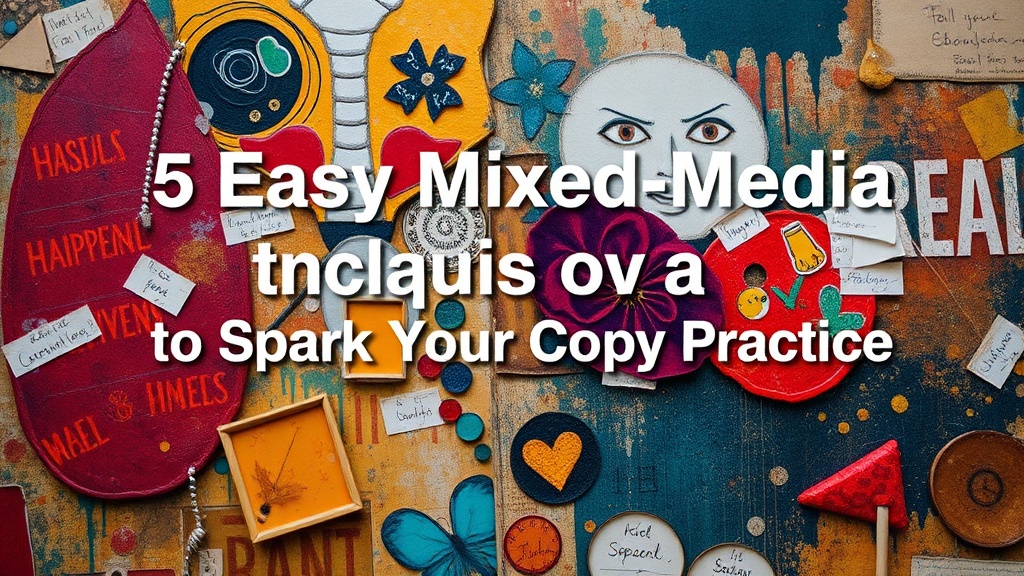
5 Easy Mixed-Media Techniques to Spark Your Creative Practice
Dry Brush Texture Over Acrylic Washes
Collage with Found Paper and Ephemera
Sgraffito Through Wet Paint Layers
Stamping and Stenciling for Pattern
Adding Dimension with Gel Medium
This post covers five approachable mixed-media techniques designed to break creative blocks and expand visual vocabulary. Mixed-media art lets you combine paint, paper, texture, and found objects into unified compositions without rigid rules. Whether you're staring at a blank canvas or looking to push past watercolor burnout, these methods offer low-stakes experimentation with high visual payoff. Each technique builds on skills you likely already have—cutting, painting, gluing—while opening doors to more complex contemporary work.
What Is Mixed-Media Art and Why Should Beginners Try It?
Mixed-media art is any artwork that combines two or more materials or techniques into a single piece. Think acrylic paint layered over old book pages, charcoal sketches enhanced with collage, or ink drawings sewn into fabric. The form has roots in early twentieth-century modernism—artists like Joseph Cornell and Kurt Schwitters broke boundaries by bringing everyday objects into gallery spaces. Today, mixed media isn't confined to museums. It's one of the most accessible entry points into contemporary art because there's no "wrong" way to combine materials.
Here's the thing: perfectionism kills creativity. Mixed media invites imperfection. A ripped edge becomes a design element. A smudged ink line gets covered with tissue paper. The process rewards curiosity over technical precision, making it ideal for beginners who feel intimidated by traditional drawing or painting. You can start with whatever supplies are already on hand and grow from there.
What Supplies Do You Need to Start Mixed-Media Art?
You don't need much to begin. A handful of quality basics will carry you further than an overflowing drawer of half-used supplies. Start with a sturdy surface, a reliable adhesive, a few paint options, and some mark-making tools.
Worth noting: paper choice matters more in mixed media than in straight drawing. Wet applications—glue, gesso, paint—will warp lightweight sketchbook pages. Here's how common options stack up:
| Paper | Best For | Weight | Price Point |
|---|---|---|---|
| Strathmore 400 Series Mixed Media | Heavy wet layering, collage | 184 lb | Budget-friendly |
| Canson XL Mixed Media | Sketching and light washes | 98 lb | Very affordable |
| Arches Oil Paper | Impasto and oil-acrylic hybrid work | 140 lb | Mid-range |
| Stonehenge Aqua Hotpress | Fine detail and smooth layering | 140 lb | Mid-range |
For adhesives, Mod Podge Matte works well for paper collage, while Golden Soft Gel Medium offers a more archival, artist-grade bond. A basic set of Liquitex Basics Acrylics provides reliable pigment at a low cost. Add a Uniball Signo white gel pen and a few Faber-Castell Pitt artist pens for detailing on top of dried paint. A simple palette knife and an old credit card round out the tool kit for spreading mediums and scraping back layers.
Technique 1: Collage and Layered Paper
Collage forms the backbone of most mixed-media work. It's fast, forgiving, and instantly adds complexity to a flat surface. Start by collecting papers that speak to you—old maps, sheet music, newspaper clippings, painted deli paper, or patterned scrapbook sheets. Even junk mail and grocery receipts can find new life under a layer of paint.
The process is simple. Tear (don't cut) the edges for a softer, more integrated look. Adhere the paper to your surface using gel medium or glue, working from the background to the foreground. Let each layer dry before adding the next. That said, complete dryness isn't always necessary—sometimes wet paint over damp collage creates unexpected bleeds that look better than planned. Embrace the unpredictability.
Build at least three layers: a base paper layer, a paint or ink layer, and a top detail layer. This creates visual depth without overwhelming the composition. The catch? Too many layers and the piece turns to mud. Step back often. If an area feels too busy, paint a semi-transparent glaze over it to push it back visually. Collage isn't just about adding—it's about editing.
Technique 2: Building Texture with Acrylic Mediums
Flat images can feel lifeless. Texture changes that. Acrylic mediums—products mixed with or applied alongside paint—let you build dimensional surfaces that catch light and cast tiny shadows. Even a thin wash of color over raised texture creates more interest than the same color on a smooth plane.
Light molding paste (Golden makes an excellent version) dries to a soft, absorbent white finish that accepts watercolor, ink, and acrylic. Spread it through a stencil with a palette knife, or drag a comb through it for linear texture. For heavier peaks and ridges, try Liquitex Flexible Modeling Paste. You can also press found objects—lace, mesh, bubble wrap—into wet paste to capture their imprint.
Here's the thing: texture needs restraint. One or two focal textured areas draw the eye; an entire page of heavy impasto feels like visual noise. Let the texture dry completely—usually four to six hours—before painting over it. Patience pays off. A dry surface won't lift or mix muddy colors into your carefully chosen palette.
Can You Combine Watercolor and Acrylic in the Same Piece?
Yes, you can combine watercolor and acrylic in the same piece, though the order of application matters. Watercolor is inherently transparent and reactivates with water. Acrylic, once dry, becomes permanent plastic. Putting watercolor on top of dried acrylic usually results in the pigment beading up or sliding off the surface. The two mediums aren't enemies—they just need a proper introduction.
The solution is straightforward. Lay down watercolor washes first. Let them dry. Then add acrylic highlights, opaque shapes, or textured details on top. Winsor & Newton Cotman Watercolors offer student-grade reliability for the base layer, while Daler-Rowney System3 Acrylics provide affordable opacity for the top layers. This combination—translucent underpainting with opaque accents—is a classic approach used by many contemporary illustrators.
Worth noting: you can also use acrylic as a resist. Paint an acrylic shape, let it dry, then wash watercolor over the entire surface. The acrylic areas will repel the watercolor, creating a stained-glass effect. It's a simple trick that looks sophisticated. Try painting abstract shapes or lettering with cheap craft acrylics before flooding the page with a single watercolor wash.
Technique 4: Image Transfers with Gel Medium
Image transfers allow you to move a printed photograph or magazine clipping onto your artwork so the paper backing disappears—only the ink remains, embedded in a thin skin of gel medium. The result is ethereal, aged, and deeply integrated into the surface. Unlike regular collage, where the paper edge is visible, a successful transfer looks as if the image grew out of the paint itself.
You'll need Golden Soft Gel Medium and a laser-printed image (inkjet prints tend to bleed). Brush a thick layer of gel medium onto your artwork surface. Press the image face-down into the wet gel. Burnish it firmly with a brayer or the back of a spoon. Let it dry overnight—rushing this step almost always causes the image to tear.
The next day, dampen the paper backing with a wet sponge. Gently rub the paper away in small circles. The image will slowly emerge, sometimes patchy, sometimes perfect. That said, some paper fuzz always remains—that's part of the charm. Seal the transfer with a thin gel medium coat when finished. If the transfer tears, collage a small paper scrap over the damage and call it intentional layering.
How Do You Fix Mistakes in Mixed-Media Art?
You can fix most mixed-media mistakes by covering them with another layer. That's the beauty of the medium—nothing is final until you say it is. Paint over an awkward collage element with opaque acrylic. Glue a new paper layer on top of a failed transfer. Sand back thick texture paste and start again. The work is built, unbuilt, and rebuilt until it feels right.
For small errors, a Uniball Signo white gel pen can disguise wayward ink lines or add faux highlights. For larger problems, titanium white acrylic paint is your best friend—it blocks almost anything underneath. The catch? Each fix adds physical thickness. If you're working in a bound journal, heavy corrections can make pages buckle or refuse to close flat.
Here's the thing: some mistakes aren't mistakes at all. A smudge becomes a shadow. A crooked line suggests movement. Before reaching for the white-out, pause and look. The "error" might be the most interesting part of the piece. Contemporary artists from Jean-Michel Basquiat to Julie Mehretu have built careers on the visual energy of so-called accidents.
Technique 5: Found Object Assemblage
Mixed media doesn't have to stay flat. Found object assemblage brings three-dimensional elements—buttons, rusted metal, fabric scraps, broken jewelry, dried seed pods—into the picture plane. This technique connects artwork to the physical world in a way paint alone rarely achieves. Every object carries its own history, texture, and weight.
Start small. A single button sewn onto a painted canvas adds enough dimension to cast a shadow. A strip of cheesecloth dipped in gel medium and draped across a surface dries into a ghostly web. As confidence grows, so can the objects. Try embedding a rusted washer into wet texture paste, or stitching a strip of vintage fabric through holes punched in watercolor paper.
Attachment is key. Lightweight items stay put with gel medium or Mod Podge. Heavier pieces need E6000 industrial adhesive or a hot glue gun. If you're building something truly sculptural, consider a rigid substrate like cradled wood panel instead of paper. Wood panels won't warp under the weight of metal or thick layering, and they're readily available from brands like Ampersand and Blick Studio.
That said, not every object belongs in every piece. The best assemblage work maintains visual cohesion. A rusted washer looks right at home in an earthy, textural piece. It clashes in a pastel floral composition. Trust the materials—and trust your eye. If an object feels forced, it probably is.
Mixed-media art rewards the curious. It breaks rules, embraces accidents, and proves that sophisticated contemporary work doesn't require an MFA or a studio full of expensive supplies. Pick one technique. Gather a few materials from the kitchen drawer or the recycling bin. Make a mess. The next layer is always waiting.