Ceija Stojka Just Got Her First Major U.S. Show. The Art World Owes Her 50 Years of Attention.
Let's look at what structural erasure actually looks like.
It doesn't look like a bonfire. It doesn't look like censorship or a banned list or a blackout. It looks like a woman surviving Auschwitz, Bergen-Belsen, and Ravensbrück. It looks like that same woman going home to Vienna, raising children, selling carpets at a market stall, and then—at fifty-five years old—starting to paint because the testimony wouldn't stop pressing against the inside of her ribcage. It looks like her creating some of the most searing visual documentation of the Holocaust in existence: raw, hot-colored, formally primitive in the best sense, unmistakably alive. And it looks like the art world largely shrugging.
Ceija Stojka died in Vienna in January 2013 at seventy-nine. She never had a major retrospective in the United States while she was alive.
The Drawing Center's Ceija Stojka: Making Visible, which opened February 20 and runs through this spring at 35 Wooster Street in SoHo, is trying to fix that. It is the most important exhibition I've seen in New York this season, and probably this year. I want you to go. But I also want to be honest about what going means, and about why it took this long.
Who She Was
Stojka was born in 1933 in Styria, Austria, to a Lovari Roma family that had been horse traders for generations — a life she'd later describe as full of color, movement, community, and the particular freedoms of people who live outside the margins of settled existence. Her father Karl and two of her brothers were murdered by the Nazis. She, her mother, and her surviving siblings were deported to Auschwitz-Birkenau in 1943. She was ten years old. They passed through Bergen-Belsen and Ravensbrück before Allied liberation in 1945.
She was twelve when the war ended.
Stojka spent the following decades in Vienna. She wrote memoirs — Wir leben im Verborgenen (We Live in Hiding), published in 1988, was one of the first first-person accounts of the Roma genocide (the Porajmos) written in German. But it was painting that became her primary testimony. She picked up the brush in her mid-fifties, with no formal training, and made work until she died.
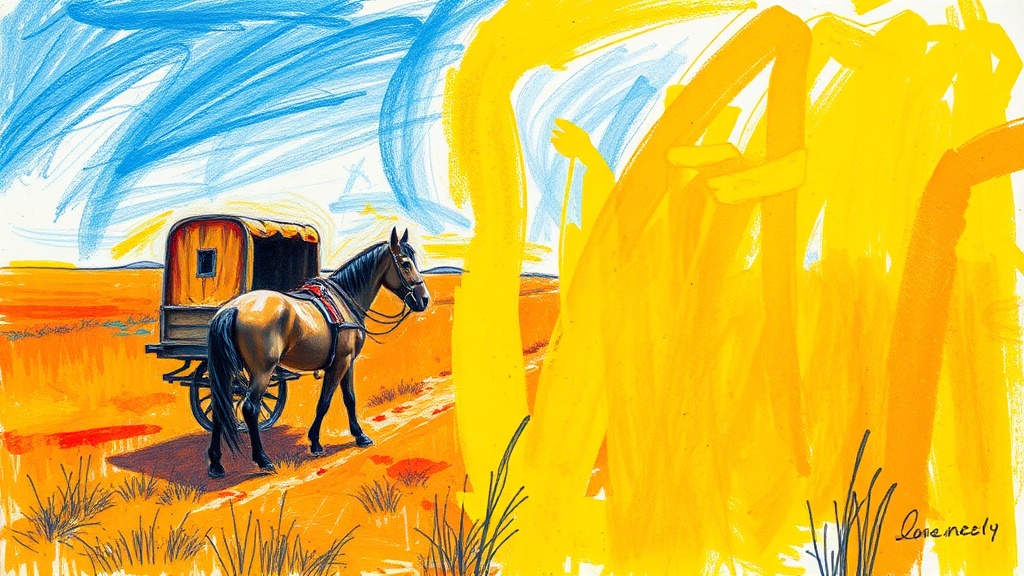
Here's what the work looks like: barbed wire in acid yellow. Figures in striped uniforms with the faces of people, not symbols. Her mother, identifiable, searching. Children who have not yet learned to make themselves invisible. And alongside the camp paintings — equally important, and this is the part that gets chronically underwritten — paintings of Roma life before. Camp life at a clearing, horses, gathered families, a freedom that the Nazis were explicitly trying to erase from history by calling it nothing worth keeping.
Stojka's paintings do two things simultaneously that most Holocaust art doesn't dare attempt: they bear witness to atrocity and they insist on joy. On the reality of what was lost, not just what was suffered. That's harder to look at than grief alone. It demands more of you.
Why the Art World Left Her Out
I want to be precise about this because it matters and because vagueness here is its own form of erasure.
Stojka wasn't invisible because no one knew about her. She was reviewed, occasionally, in European contexts. She showed in Austria and Germany and France. Her books were translated. She was not a secret. She was what the art world is very good at creating: a person who exists just barely within the field of vision, acknowledged enough that you can't say she was ignored, visible never quite enough to be centered.
Part of this is familiar sexism — the reflexive undervaluation of women artists that we've documented exhaustively and still somehow haven't fixed. Untrained women artists in particular get filed under "outsider art," which is a category that functions, more often than we admit, as a way to appreciate work while keeping it out of the canon. It's a compliment with a ceiling.
But there's something more specific happening with Stojka, and the institution that finally gave her this retrospective has to sit with it: she was Roma. The Porajmos — the Nazi genocide of Roma people, which most major Holocaust institutions estimate killed at least 200,000 to 500,000 people, with many historians arguing the true figure is significantly higher — remains staggeringly absent from mainstream Holocaust memory culture. Institutions that would never dream of minimizing Jewish suffering have done exactly that to Roma suffering, repeatedly, for eighty years. Stojka's work is inseparable from Roma identity and Roma testimony. The art world's discomfort with one is inseparable from its disinterest in the other.
So we have a perfect storm: woman, untrained, Roma, survivor documenting a genocide that institutions haven't fully processed. The result was that a painter making some of the most urgent visual testimony of the twentieth century spent twenty-five years making it in relative obscurity.
That's not an accident. It's a system.
What the Show Does
Making Visible is substantial — this isn't a token gesture toward repair. The Drawing Center, which has always been serious about drawing as a primary medium (Stojka worked extensively in colored pencil and pastel alongside oil and acrylic), has given the work room to breathe and accumulate.
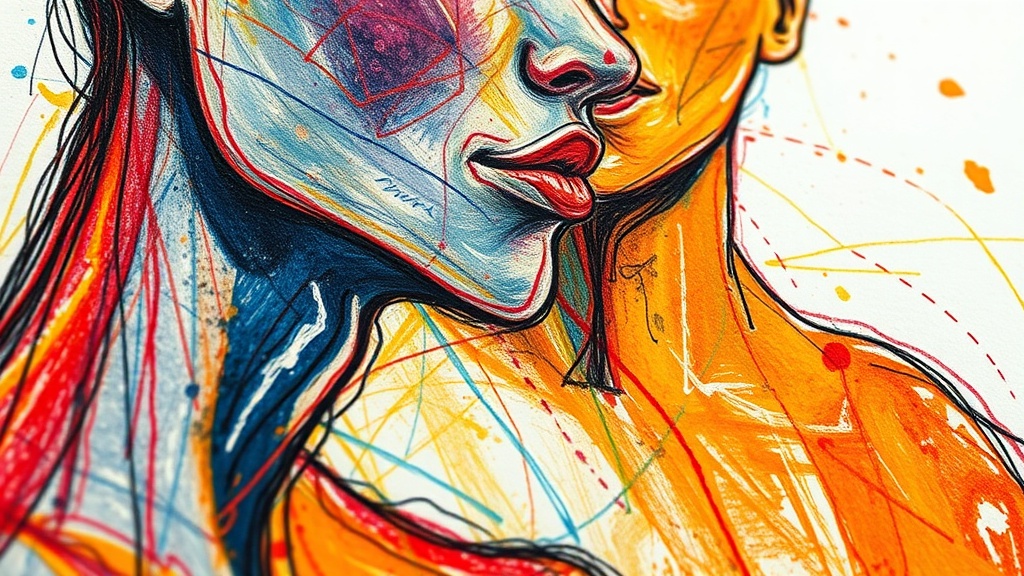
What strikes me most seeing the work gathered is how formally controlled Stojka's expressionism is, despite initial appearances. The figures are simplified the way children's drawings are simplified — not because she couldn't render but because reduction is how you get to essence. The barbed wire in her camp paintings isn't rendered naturalistically; it becomes a kind of text, a mark-making that says here is the thing that divided life from death. The colors are not what you'd choose for scenes of atrocity if you were designing for effect. They're bright, often. Oranges and reds and saturated blues. Because that's what memory actually looks like when it comes for you — not muted, not sepia, but blazing and close.
The pre-deportation paintings hit differently than I expected. There's a painting of family at camp in the old sense — children running, a fire, a wagon — that reads simultaneously as a specific memory and as a kind of manifesto: we existed, we had beauty, you cannot un-have it. That defiance is not the defiance of someone performing resilience for an audience. It's something older and more private. You're not supposed to be in the room with it. The fact that you are is a gift.
The works on paper deserve particular attention. Stojka's colored pencil drawings are where you see the intimacy most clearly — small-scale, intensely worked, the pressure of the pencil somehow audible in the final surface. Don't rush past them to get to the paintings.
The Question You Should Leave With
Here's what I keep coming back to: Stojka started painting in 1988 and died in January 2013 — twenty-five years of work, made while American institutions were supposedly expanding their commitments to survivor testimony and underrepresented voices. The Drawing Center opened in 1977. It took until 2026 — thirteen years after her death — to give her this show.
If it took this long to center Stojka in the American art institution, what are we missing right now? Not in the past — now. What artist is making urgent, necessary work in a language or community or medium that our institutions have decided counts as secondary? Whose testimony is accumulating unseen while we congratulate ourselves on our commitment to diversity by doing the same retrospective for the same twelve artists we always celebrate?
This is not rhetorical. It's an actual question. Institutions should be required to answer it publicly, with receipts.
Go See It
Ceija Stojka: Making Visible is at the Drawing Center, 35 Wooster Street in SoHo, Manhattan. The show runs through spring 2026. Check thedrawingcenter.org for current hours and admission before you go — they typically offer free admission on Friday evenings as part of their Open Hours program, which is worth planning around.
Give it at least ninety minutes. More if you can. The work is dense and it asks something of you — don't go in a rush. Go on a day when you have the emotional bandwidth to actually look. Bring someone who doesn't know her name yet. That's most people. That's the problem.
This is the show I'll tell people about when they ask what mattered this season. Go before it closes. Tell someone else to go. Then ask your museum, your gallery, your institution: who are you still not showing?
— Nadia