Jon Burgerman's First New York Solo Show Is a Tender, Melancholy Surprise

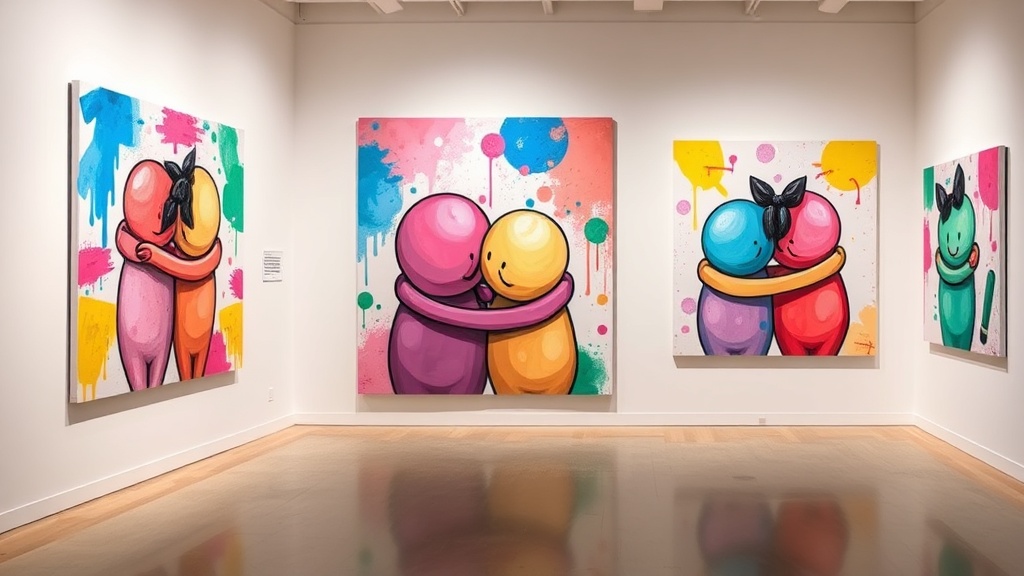
The first thing that hits you walking into A Hug From The Art World is the color. Hot pinks, electric blues, sunny yellows — these are not shy paintings. Jon Burgerman's Hold On, It Won't Last Long fills the gallery with twenty new canvases that look like they could have been spray-painted on a Brooklyn wall by the world's most talented doodler. And they kind of were.
Burgerman has lived in New York for fifteen years. Fifteen. But this is his first proper solo gallery show in the city. If that sounds wild, consider that he's been busy building something much bigger than gallery walls allow — murals in Seoul, collaborations with Apple and Samsung, a Sesame Street partnership, hot dog pool floats, and a picture book called How to Eat Pizza that's probably being read to a toddler right now somewhere in the world.
But here's what's interesting about this show: Burgerman isn't just showing up with more of the same happy, googly-eyed characters that made him Instagram-famous. These paintings are recognizable as his work — same rounded blobs, same squiggly lines, same immediate, almost childlike mark-making — but there's something new underneath. Something quieter.
What The Paintings Look Like
Each canvas features Burgerman's signature blob-figures — soft, amorphous shapes that read as bodies without being literal bodies. He paints them with spray paint and oil stick, which gives the surfaces a velvety, slightly gritty texture. The spray paint creates halos and soft edges; the oil stick adds those decisive, cartoony lines that define eyes, mouths, the curve of a shoulder.
The figures are almost always embracing. Twisted together, overlapping, limbs wrapped around torsos in ways that suggest both comfort and need. But here's the melancholy twist: none of them are making eye contact.
You see a pink blob cradling a blue blob, but the pink one's eyes are closed or looking away. Two figures lean into each other like they're sharing a secret, but their faces point in opposite directions. It's tender and sad at the same time — physical closeness without emotional connection, or maybe the difficulty of expressing what's really going on inside.
The press release calls it "longing for meaningful connection," and yeah, that tracks. These feel like paintings made by someone who's been thinking about intimacy and its limits. About how hard it is to really be seen, even when someone is holding you.
The Technique: Street Art DNA in a Gallery
Burgerman uses spray paint like a street artist, but he's painting on canvas in a controlled studio environment. The contrast is part of what makes these work. You can see the drips and overspray — evidence of the medium's origins on concrete walls — but they're contained within neat rectangular frames. It's street art that's been invited indoors, given a bath, and asked to sit still.
He also leaves parts of the canvas bare in some pieces, or works on colored grounds (muted pinks, soft blues) that let the spray paint sit on top like a layer of atmosphere. The color palette is surprisingly restrained for such playful work — lots of pastels mixed with bold primaries, nothing garish, everything working together in a way that feels intentional rather than random.
The oil stick lines are confident. This is someone who has drawn thousands of these blob-figures and knows exactly where to place an eye to make it look curious, or a mouth to make it look worried. There's no hesitation in the marks, which is its own kind of pleasure to look at.
The Theme: Holding On, Letting Go
The title Hold On, It Won't Last Long works on multiple levels. There's the obvious — the embrace, holding each other. But there's also the Buddhist-ish reminder that everything is temporary, including the moment of connection these figures are trying to achieve.
Burgerman has said he wants his work to live "through people" — to exist beyond the gallery walls on phone cases, t-shirts, pool floats. This exhibition is an interesting pivot because it feels more personal, more interior, than his public-facing commercial work. These aren't characters designed to sell merchandise. They're grappling with something more private.
There's a generosity to that. An artist with Burgerman's platform could easily phone it in with more of the same happy, marketable imagery. Instead, he's showing us something slightly uncomfortable: the gap between physical closeness and emotional understanding.
Where It Sits in His Career
Comparisons to Keith Haring are inevitable — both artists work in a bold, graphic, immediately legible style; both blur the line between street art and fine art; both have built commercial empires alongside their studio practices. But Haring's work was about community, activism, the energy of the city. Burgerman's feels more interior, more about individual psychology.
He's also working in a moment when the art world is finally taking illustration and "low" art forms seriously. Fifteen years ago, an artist with Burgerman's commercial portfolio might have been dismissed as not serious enough for a solo gallery show. Now the gallery is catching up to where the audience already was.
What I Loved
The color relationships. Burgerman has an intuitive sense for how pink talks to blue, how yellow activates a field of lavender. Looking at these paintings is like eating a really well-made dessert — every element works together, nothing fights.
I also loved the emotional complexity. You can walk in and enjoy these as cheerful, colorful abstractions. But if you spend time with them, the melancholy reveals itself. They're not sad paintings exactly, but they're not purely joyful either. They're honest about how hard connection actually is.
What I'm Thinking About
Whether the tension between Burgerman's commercial accessibility and this more vulnerable gallery work will hold. His whole ethos is about art being for everyone, which is great, but there's a risk that the work becomes so eager to please that it loses its edge. These paintings suggest he's aware of that risk and is trying to push in a different direction.
Also, the gallery itself — A Hug From The Art World is a relatively new space (founded in 2019) with a mission to show work that bridges commercial and fine art. It's the perfect fit for Burgerman, and their enthusiasm for this show is palpable.
The Practical Info
Where: A Hug From The Art World, 515 West 19th Street, New York, NY 10011 (Chelsea)
When: January 22 – March 7, 2026
Hours: Tuesday – Saturday, 10 AM – 6 PM (Closed Sunday and Monday)
Admission: Free
Getting there: C or E train to 23rd Street, then walk south about 5 blocks. The gallery is in a converted garage space that fits the street-art energy of the work.
Worth the trip? Yes, especially if you're interested in how street art aesthetics translate to gallery contexts, or if you've only seen Burgerman's commercial work and want to see what else he's capable of. The show runs through early March, so you have time, but don't sleep on it.
Who should go: Anyone who's ever felt lonely in a crowd. Anyone who likes their contemporary art with a sense of humor and a streak of melancholy. Anyone who's skeptical that art needs to be difficult to be serious. Take a friend — you'll want to talk about the eye contact thing afterward.
Pro tip: The gallery is small, so weekday afternoons are quieter if you want time to really look. And yes, there is merchandise — but it actually feels appropriate here, given Burgerman's whole philosophy. The catalog is worth picking up.