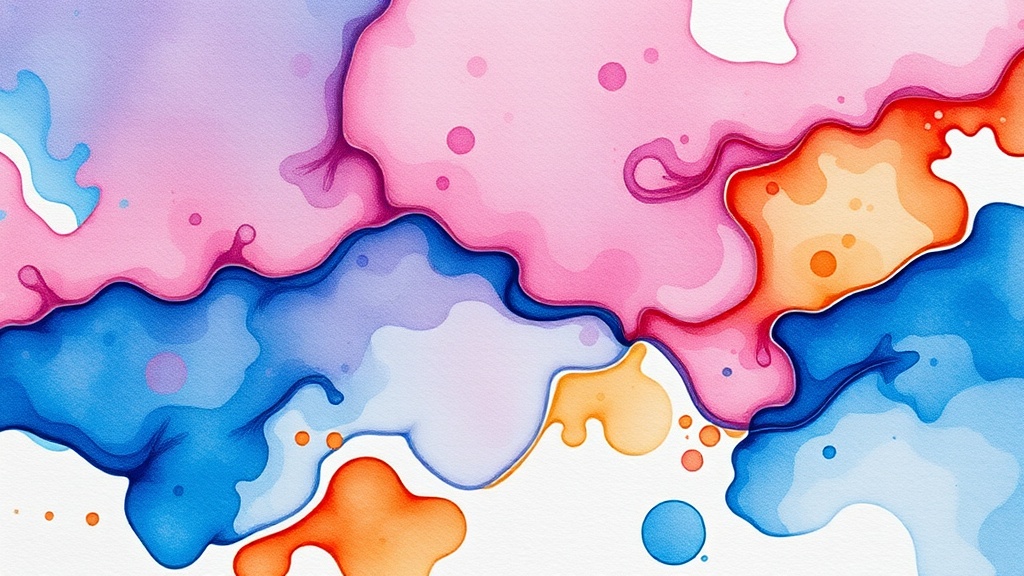
Mastering Watercolor Washes: A Beginner's Guide to Fluid Techniques
The Foundation of Watercolor: Understanding Washes
This guide covers the four fundamental watercolor wash techniques—flat, graded, wet-on-wet, and variegated washes—along with the specific materials, paper preparation methods, and common troubleshooting solutions that transform muddy puddles into luminous color fields. Watercolor intimidates many beginners because the medium behaves unpredictably; pigment suspended in water moves according to gravity, evaporation rates, and paper texture rather than direct control. Learning to manipulate washes provides the technical foundation for everything from atmospheric landscapes to detailed botanical illustrations. The techniques described here apply universally across brands and skill levels, from student-grade Prang watercolors to professional Winsor & Newton tubes.
What Makes a Wash Different from Regular Painting
A wash is not simply "painting with thin paint." In watercolor terminology, a wash refers to a deliberate application of diluted pigment across a defined area where the color remains fluid and self-leveling during application. The critical difference lies in the water-to-pigment ratio and the working time.
Professional watercolorists typically work with washes containing 70-80% water to 20-30% pigment for initial layers. This high water content allows the pigment to settle into the paper's microscopic valleys, creating that characteristic stained-glass luminosity when held to light. Compare this to opaque mediums like acrylic or gouache, where pigment concentration usually exceeds 50% and sits on the surface rather than absorbing into it.
The paper matters significantly. Cold-pressed Arches 140 lb (300 gsm) cotton paper remains the industry standard for wash practice because its uniform texture prevents pooling while allowing controlled backruns. Hot-pressed paper (smooth surface) accelerates drying time to 2-3 minutes versus 8-12 minutes on cold-pressed, making it less forgiving for beginners learning to manipulate wet pigment.
The Four Essential Wash Techniques
Flat Wash: The Building Block
A flat wash produces an even, uniform color value across the entire painted area. This technique underpins architectural rendering, technical illustration, and comic book coloring. Despite appearing simple, achieving true flatness requires specific brush handling.
Materials needed: A 1.5-inch flat synthetic brush (Silver Brush Black Velvet series, approximately $18), a slanted board set at 15-20 degrees, and sufficient pre-mixed paint in a separate well.
The method:
- Mix enough pigment to cover the area completely—running out mid-wash creates visible seams. For a 5x7 inch area, prepare at least 3 tablespoons of diluted paint.
- Set the paper at a slight angle to allow gravity-assisted flow.
- Load the brush fully and draw a horizontal stroke across the top edge.
- Immediately draw the next stroke slightly overlapping the first while the edge remains wet.
- Continue downward, gently tilting the paper side-to-side to redistribute excess pigment pooling at the bottom.
- Blot the bottom edge with a dry paper towel to prevent backruns.
The entire sequence must complete within 90 seconds on standard 140 lb paper at 70°F (21°C) room temperature. Practice on scrap paper first—flat washes reveal every hesitation and uneven pressure variation.
Graded Wash: Creating Depth Through Value Change
Graded washes transition smoothly from dark to light (or vice versa) across a single continuous application. This technique creates atmospheric perspective in landscapes, three-dimensional form in still life, and dramatic lighting effects.
The key variable is water addition rather than pigment reduction. Starting with a pigment-heavy mixture (approximately 40% pigment to 60% water), each subsequent stroke incorporates 10-15% more clean water. The transition should occur over a minimum of 6-8 brush widths to appear gradual rather than striped.
Painter Steve Mitchell, whose YouTube channel "The Mind of Watercolor" demonstrates over 400 technique videos, recommends practicing graded washes with ultramarine blue specifically because its granulating properties make value changes visually obvious. Cobalt blue and quinacridone gold also demonstrate excellent gradation characteristics, while phthalo colors (phthalo blue, phthalo green) stain aggressively and resist smooth transitions.
Wet-on-Wet: Embracing Controlled Chaos
Wet-on-wet application involves laying pigment onto pre-wetted paper. The pigment spreads according to moisture gradients, creating soft, blurred edges impossible to achieve through direct application. J.M.W. Turner built his atmospheric seascapes almost exclusively through layered wet-on-wet techniques.
Preparation protocol:
- Apply clean water evenly using a large hake brush or spray bottle
- Wait 30-60 seconds for the paper to reach "glossy but not pooled" saturation
- Test with a fingertip—the paper should feel cool but not transfer water to the skin
At this moisture level, a drop of quinacridone rose will spread approximately 2-3 inches in diameter over 45 seconds. Adding more pigment creates denser color at the center; dropping clean water into the wet pigment creates "cauliflowers" or backruns—sometimes desirable for texture, often catastrophic for controlled work.
The Winsor & Newton Professional Watercolour range includes 96 colors, but only approximately 40 perform predictably in wet-on-wet applications. Colors rated "granulating" (such as French ultramarine, raw sienna, and lunar black) separate into component pigments as they dry, creating textured, crystalline effects. "Staining" colors (phthalo turquoise, permanent alizarin crimson) sink immediately into paper fibers and resist lifting or manipulation.
Variegated Wash: Multiple Colors, Single Application
Variegated washes introduce multiple colors into a single wet area, allowing them to blend at the boundaries while maintaining distinct color zones. This technique creates sunset skies, iridescent water surfaces, and autumn foliage without over-mixing into mud.
The critical rule: limit the palette to analogous colors (adjacent on the color wheel) or complementary pairs that neutralize intentionally. Adding three unrelated hues—say, red, yellow, and blue—in equal proportions guarantees brown-gray results.
Effective variegated combinations include:
- Cadmium yellow deep + quinacridone burnt orange + perylene maroon (sunset gradients)
- Phthalo blue (red shade) + phthalo turquoise + permanent green deep (tropical water)
- Quinacridone violet + ultramarine blue + indigo (twilight shadows)
Apply the first color to its designated area, then immediately introduce the second color with 1-inch overlap at the boundary. The colors will fuse for approximately 90 seconds before setting. Tilting the board controls the fusion zone width—steeper angles (30+ degrees) create narrower blend areas.
Common Failures and Specific Solutions
Blooms and Cauliflowers
These organic, flower-like textures occur when a wetter application touches a drier area. The water from the wetter section rushes into the drier zone, carrying pigment and depositing it at the edges. While sometimes used deliberately for foliage or coral textures, blooms ruin intended flat washes.
Prevention: Maintain consistent wetness across the entire wash area. Work quickly enough that previous sections remain damp when new sections join. Use a hair dryer to force complete drying before adjacent applications if controlled edges are required.
Correction: Once dry, blooms cannot be erased from non-staining pigments. For staining pigments, aggressive scrubbing with a stiff brush and Magic Eraser sponge may lift 60-70% of the color. The remaining ghosting is usually covered by subsequent opaque layers or incorporated as texture.
Hard Lines and Tidal Marks
When washes dry, pigment migrates to the edges as water evaporates, leaving darker lines. On flat washes, this creates unwanted borders; on graded washes, it disrupts smooth transitions.
The solution involves "washing the brush"—running a clean, damp brush along the bottom edge of a developing wash to collect accumulating pigment. Alternatively, tilt the paper at 45 degrees so the pooled pigment collects at a corner rather than along an edge, then blot with paper towel.
Muddy Colors
Mud results from overworking—applying brush strokes to an area that has begun setting. Each additional stroke re-wets underlying layers, causing pigments to mix rather than layer cleanly. The threshold varies by pigment: granulating colors tolerate more manipulation than staining colors.
Apply each wash in a single pass. If the result disappoints, wait for complete drying (typically 15-20 minutes for heavy applications) before applying a correction glaze rather than attempting immediate fixes.
Equipment Specifics That Actually Matter
Brush quality affects wash success more than paint quality. A $3 Princeton Aqua Elite synthetic brush outperforms a $40 natural hair brush that sheds fibers into wet paint. For wash work, synthetic flats in 1-inch and 2-inch widths provide consistent water release and spring.
Paper is non-negotiable. Canson XL watercolor pads ($15 for 30 sheets) contain wood pulp rather than cotton, causing washes to dry unevenly and lift unpredictably. Arches or Fabriano Artistico 140 lb cotton paper ($35-45 for 20 sheets) provides consistent absorption that makes technique practice meaningful rather than frustrating.
Palette selection impacts mixing accuracy. White ceramic or enamel palettes (such as the $24 Jack Richeson porcelain butcher tray) show true color values, while colored plastic palettes distort perception and lead to over-pigmented mixtures.
Structured Practice Routine
Skill development requires deliberate exercise rather than random painting. This 45-minute daily routine isolates variables:
- Days 1-3: Flat washes only. Fill five 4x6 inch rectangles daily with different colors, aiming for uniformity visible under raking light. Success metric: no visible brush strokes or tide marks.
- Days 4-6: Graded washes. Practice vertical and horizontal gradations. Success metric: smooth value transition from 90% to 10% pigment density without visible steps.
- Days 7-9: Wet-on-wet. Apply two colors to pre-wetted paper, observing fusion boundaries. Success metric: controlled 0.5-inch blend zone without colors mixing to neutrality.
- Days 10-12: Variegated washes. Combine three analogous colors. Success metric: distinct hue zones with soft boundaries, no muddy intermediate areas.
Document each practice session with phone photography in consistent lighting. Compare Day 1 and Day 12 images—the improvement in edge control and value consistency becomes objectively visible.
Moving Beyond Technical Exercise
Once these four wash types become predictable, they combine into complex imagery. A typical landscape might use a graded wash for sky, wet-on-wet variegated washes for distant hills, and flat washes with glazing for foreground architecture. The 19th-century British watercolor tradition—Turner, Cotman, De Wint—built entire careers on sophisticated wash manipulation without additional techniques.
Contemporary artist Jean Haines produces bestselling instructional books ("Jean Haines' Atmospheric Watercolours," Search Press, 2014) demonstrating how far pure wash technique extends. Her portrait work uses only wet-on-wet application, achieving recognizable likenesses without line drawing or dry brush detail.
The gatekeeping around watercolor—claims that it requires innate talent or decades of study—dissolves under systematic practice. These are physical skills involving water, pigment, and cellulose. Understanding the material behavior replaces mystique with mechanics. The luminosity that makes watercolor distinctive emerges automatically when the technical variables align.