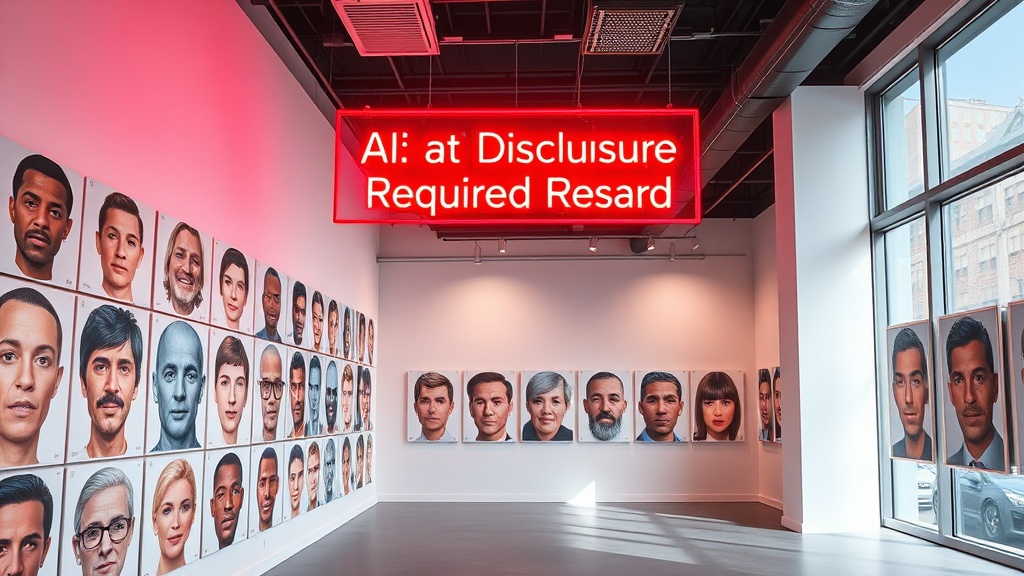
NY AI Disclosure Law: What NYC Artists Need to Know
Imagine stepping into a gallery and seeing a portrait that looks exactly like a famous celebrity—only it was never painted by a hand. That’s the new reality for many New York art spaces, and a fresh law is about to make that distinction crystal‑clear.
On June 9, 2026, New York will enforce a groundbreaking AI image disclosure statute that forces any synthetic performer or AI‑generated likeness used in advertising, exhibitions, or sales to be labeled conspicuously. For us artists, curators, and collectors, it’s not just a legal footnote—it’s a shift in how we talk about, sell, and experience digital art.
What exactly does the New York AI Disclosure Law require?
The law, codified in S.8828 (RAISE Act amendment) and A.8884, expands the state’s right‑of‑publicity protections and introduces a “synthetic performer” definition. In plain English, any image, video, or audio generated—or heavily altered—by artificial intelligence that depicts a real person (living or deceased) must carry a clear disclosure.
When does it take effect?
The statutes were signed in December 2025 and become enforceable on June 9, 2026. That gives us roughly three months to audit portfolios, update signage, catalogs, and digital listings.
Which works fall under the law?
- AI‑generated portraits or sculptures of identifiable individuals.
- Deep‑fake videos used in promotional material.
- Any synthetic performance (voice or movement) that mimics a real person in advertising or commercial contexts.
Purely fictional AI creations—think abstract generative pieces that don’t resemble a specific person—are exempt.
How does this impact artists and galleries?
For many of us, tools like Midjourney, DALL‑E, or Runway have become part of the creative toolbox. The law forces a new layer of transparency that can feel both bureaucratic and liberating.
Do I need to label synthetic performers in ads?
Yes. Any promotional material—online ads, printed flyers, social‑media posts—must include a conspicuous statement such as “Image generated by AI” or “Featuring AI‑created likeness of [Name].” The wording should be legible and placed where a viewer would naturally notice it.
What about existing AI‑generated artwork?
If the piece does not depict a recognizable real person, you’re in the clear. However, many AI portrait tools inadvertently produce faces that resemble celebrities or public figures. In those cases, treat the work as a synthetic performer and add a disclosure.
Practical steps to stay compliant
Compliance can be broken down into three manageable actions.
1. Add clear disclosures
Update every piece of marketing copy, label on‑site plaques, and online catalogue entries. Use a standard badge—think a small orange banner that reads “AI‑Generated” or “Synthetic Performer.” Consistency is key; the law looks for “conspicuous” labeling, not a footnote buried in fine print.
2. Update contracts and permissions
If you license AI‑generated works that feature real people, obtain written consent that acknowledges the upcoming disclosure requirement. This protects both the artist and the subject from future legal disputes.
3. Keep records of AI model usage
Maintain a simple spreadsheet: date, tool used (e.g., Midjourney v5), prompt, and whether the output includes a recognizable likeness. Should a complaint arise, you’ll have a paper trail showing good‑faith effort.
What are the penalties for non‑compliance?
Violations can trigger civil penalties up to $5,000 per infringing instance, plus potential damages if a right‑of‑publicity claim is filed. The New York Attorney General’s office will prioritize cases that involve commercial advertising, but galleries that sell AI‑generated works without disclosure could also face scrutiny.
How does this fit into the broader AI‑in‑art conversation?
New York isn’t the only jurisdiction grappling with AI ethics. California’s SB 53 and the federal “AI Transparency” executive order are shaping a patchwork of rules. For us in the art world, the conversation is less about restriction and more about honesty: letting viewers know when a brushstroke was made by a human hand versus an algorithm.
We recently covered the $1 million AI‑generated portrait sale in AI Art Hits $1 Million, and the surge of women‑led AI exhibitions in International Women’s Day 2026. Those pieces sparked excitement, but now they’ll also need a label that says, “This is AI.”
Looking for inspiration? Check out How to Curate a Home Art Gallery Without Feeling Pretentious for practical display tips, or explore the upcoming NYC Summer Pop‑Up Art Installations to see how galleries are already integrating AI works.
Takeaway
New York’s AI image disclosure law is a wake‑up call for the entire art ecosystem. By adding clear labels, updating contracts, and documenting your AI workflow, you can stay compliant and keep the focus on what matters: the conversation the work provokes. Start today—review your upcoming exhibition catalogues before the June deadline, and let your audience know when the art is synthetic.
Frequently Asked Questions
- When does the NY AI disclosure law take effect? The law becomes enforceable on June 9, 2026, giving artists and galleries a few months to update their labels and catalogs.
- Which AI‑generated works require a disclosure? Any AI‑generated image, video or audio that depicts a recognizable real person — living or deceased — must carry a clear label.
- What penalty can galleries face for non‑compliance? Violations may incur civil penalties up to $5,000 per instance, plus possible damages if a right‑of‑publicity claim is filed.