The Best Exhibitions in New York Right Now: Your Deep-Dive Guide to Late February 2026
Sometimes the art world feels like a moving train you're trying to catch while already running.
Exhibitions open, exhibitions close. Group shows get announced with 47 artists you need to look up. Everyone's talking about something that supposedly "changes everything." And you're standing in front of a wall text wondering if you're supposed to feel something you're not feeling.
Here's what I've learned after too many gallery Saturdays: you don't need to see everything. You need to see the right things — the shows that will actually move you, challenge you, or give you something to carry with you. The rest is just noise.
So I spent the last week walking through New York's galleries and museums with one question: if a friend was visiting for the weekend and could only see five shows, which five would genuinely matter?
These are those five.
Dan Flavin: Grids at David Zwirner
Ends February 21 — this is your last weekend.
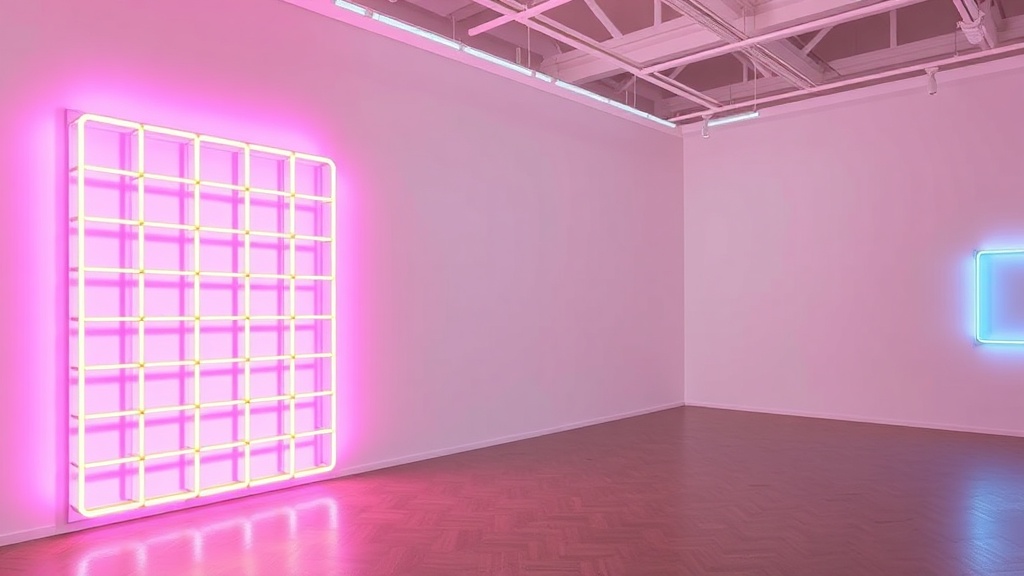
I need to start here because this show closes in six days and it would be a crime to miss it. David Zwirner's 20th Street space is hosting the first focused examination of Dan Flavin's grids — those corner-mounted fluorescent light constructions that look simple until you stand in front of one for five minutes and realize your entire sense of space has shifted.
Here's what you're seeing: fluorescent tubes arranged in grids — vertical lamps facing backwards, horizontal facing forwards — installed in corners where two walls meet. Pink, green, yellow, blue. The colors don't just sit there; they bleed into each other, reflect off the white walls, turn the corner into something that feels both architectural and impossible.
The exhibition recreates historical installations, including Flavin's tribute to his dealer Leo Castelli — a 24-foot grid spanning across a corner that hasn't been seen together since 1987. The scale is overwhelming. The colors are aggressive. The simplicity is deceptive.
What I'm still thinking about: how Flavin took the most mundane material imaginable — hardware store fluorescent lights — and made them feel sacred. There's something about the grids specifically — more than his single diagonals or his barriers — that makes you hyper-aware of your own body in space. The corner becomes a portal. The light becomes structure.
Go if: You want to understand why Minimalism still matters, or you've never stood in front of a Flavin and felt the space around you dissolve.
Skip if: You need narrative or representation — this is pure phenomenology, no story, no figure.
Details: David Zwirner, 537 West 20th Street. Through February 21. Tuesday–Saturday, 10 AM–6 PM. Free.
Caravaggio's "Boy with a Basket of Fruit" at The Morgan Library & Museum
Through April 19.
Sometimes you need 400-year-old painting to remind you what art can do. The Morgan has managed to borrow Caravaggio's "Boy with a Basket of Fruit" from the Galleria Borghese in Rome — the first time this painting has been in New York in decades — and they've built a small, perfect exhibition around it.
The painting itself is devastating. A young man (maybe a self-portrait, maybe not) holds a basket of fruit with a direct, almost confrontational gaze. His shirt slips off one shoulder. The fruit is rendered with such specificity that you can see where it's starting to rot — the wormholes, the bruises, the overripeness. It's beauty and decay in the same breath.
What's radical about this painting — what made it radical in 1593 and what still makes it radical now — is the humanity. Caravaggio painted people like people, not like idealized religious symbols. The boy's gaze meets yours. He knows you're looking. There's something almost modern about the psychology of it.
The Morgan has paired the Caravaggio with relevant works from their collection, including a "Girl with Cherries" from the Met that shows the tradition Caravaggio was both inheriting and exploding. The context helps, but honestly? You could put that painting alone in a white room and it would still stop you cold.
Go if: You think Old Masters are boring — this will prove you wrong. Or if you already love Caravaggio and want to see one of his early masterpieces up close.
Details: The Morgan Library & Museum, 225 Madison Avenue. Through April 19. Tuesday–Sunday, 10:30 AM–5 PM. $18, free Fridays 5–7 PM.
Proposal for a Monument by Yashua Klos at Sikkema Malloy Jenkins
Through March 21.
I walked into Sikkema Malloy Jenkins not knowing Klos's work and left genuinely shaken. This is his second solo show with the gallery, and it represents something rare: an artist finding a visual language that feels completely their own and also completely urgent.
Klos works in collage — but not the kind of collage you're picturing. He builds monumental portrait busts using fragmented black-and-white printed materials: newspaper clippings, construction debris, images of African masks, architectural fragments. The pieces are assembled like topographic maps or geological formations. Faces emerge from the layering, but they're never fully resolved — always in process, always in tension.
The title "Proposal for a Monument" cuts deep right now. We're in a moment when monuments are being questioned, torn down, reimagined. Klos seems to be asking: what would a monument look like that could hold complexity rather than erase it? What would it mean to commemorate Black identity without freezing it into a singular narrative?
The scale varies — some pieces are intimate, others are imposing — but they all carry weight. Literally. You can see the physical labor in the layering, the way materials are torn and pressed and built up. It's sculpture disguised as collage, or maybe the other way around.
Go if: You want to see what contemporary portraiture looks like when it refuses easy legibility. Or if you're interested in how artists are processing questions of memory, identity, and public space.
Details: Sikkema Malloy Jenkins, 530 West 22nd Street. Through March 21. Tuesday–Saturday, 10 AM–6 PM. Free.
scintille by Marguerite Humeau at White Cube
Ends February 21 — also closing this weekend.
Marguerite Humeau makes art that feels like it comes from another consciousness — not alien, exactly, but non-human. Her work at White Cube (closing the same weekend as the Flavin, so plan accordingly) draws from her research into cave ecosystems and the creatures that inhabit them.
The title "scintille" means "sparks" in Italian. The show includes sculptures that look like they grew rather than were made — bulbous, organic forms that reference the life Humeau encountered in a West Papua cave. There are creatures that navigate darkness through echolocation, through vibration, through senses we don't fully understand. Humeau seems to be trying to translate that non-visual experience into form.
Upstairs, she's dedicated an entire gallery to bats — the cave's key protagonist. The sculptures feel like they're listening. Like they're emitting frequencies you can't hear but can somehow sense.
What's compelling about Humeau's work is the research rigor combined with intuitive making. She studies biology, geology, mythology — then lets that knowledge mutate into something stranger and more speculative. The work doesn't illustrate her research; it metabolizes it.
Go if: You're drawn to art that operates on the edge of the known, or if you're interested in how contemporary sculpture can engage with ecological consciousness without being preachy.
Details: White Cube, 1002 Madison Avenue. Through February 21. Monday–Saturday, 10 AM–6 PM. Free.
Muted Rhythm at Lehmann Maupin
Through February 28.
Ending with a group show feels like cheating, but this one deserves inclusion. "Muted Rhythm" brings together artists working across painting, sculpture, and installation who share an interest in repetition, pattern, and the aesthetics of restraint.
What ties the work together is a kind of visual quietness — nothing screams for attention, but everything rewards sustained looking. There are paintings that look like textile weavings. Sculptures that reference musical notation. Installations that create rhythm through accumulation.
In a month when the art world feels loud — Biennial announcements, fair season approaching, everyone trying to get your attention — there's something restorative about an exhibition that asks you to slow down. The "muted" in the title isn't about silence; it's about frequency. These works operate on lower registers. You have to tune yourself to them.
I'm not going to name individual artists here because the show works best as an environment — a space to wander through and let the connections emerge. That's increasingly rare in gallery exhibitions, which tend toward the solo show or the tightly curated historical survey. This is looser, more atmospheric, and in its own way, more generous.
Go if: You want a palette cleanser after the intensity of Flavin and Klos. Or if you're interested in how contemporary artists are engaging with pattern and repetition outside of Minimalism's rigid frameworks.
Details: Lehmann Maupin, 501 West 24th Street. Through February 28. Tuesday–Saturday, 10 AM–6 PM. Free.
How to Plan Your Weekend
If you're serious about seeing these shows, here's a route that makes sense:
Saturday: Start at White Cube (1002 Madison) for Humeau, then walk south to the Morgan (225 Madison) for Caravaggio. Break for lunch. Head west to David Zwirner (537 West 20th) for Flavin and Lehmann Maupin (501 West 24th) for Muted Rhythm. That's four shows, and you can do it without rushing.
Sunday: Sikkema Malloy Jenkins (530 West 22nd) for Klos. Then you're free to wander Chelsea — there are always unexpected discoveries in the smaller spaces.
Pro tip: Both the Flavin and Humeau close February 21. If you're reading this after that date, prioritize the others. If you're reading this before, do not sleep on those two.
What I'm Thinking About
Walking through these exhibitions, I kept returning to the same question: what does it mean to make art that matters right now?
The Flavin offers an answer about attention — about slowing down enough to notice how space and light shape experience. The Caravaggio offers an answer about humanity — about seeing people in their full, complicated, decaying specificity. The Klos offers an answer about memory — about building monuments that can hold contradiction. The Humeau offers an answer about other consciousnesses — about making space for ways of knowing that aren't centered on human perception. And the group show at Lehmann Maupin offers an answer about community — about artists in conversation, building something together.
None of these are the "right" answer. That's the point. Art doesn't resolve into a single message. It multiplies. It complicates. It gives you more questions than answers.
That's why I do this. Not because I have opinions to share, but because the art keeps teaching me that I don't know as much as I think I do. And that's a relief, honestly. To be reminded that there's still mystery. Still surprise. Still something to discover in a room full of fluorescent lights or a 400-year-old painting of a boy holding rotten fruit.
Go see these shows. Or don't. But if you do, go with your eyes open and your expectations loose. The art will meet you where you are.
Happy gallery hopping. — Nadia