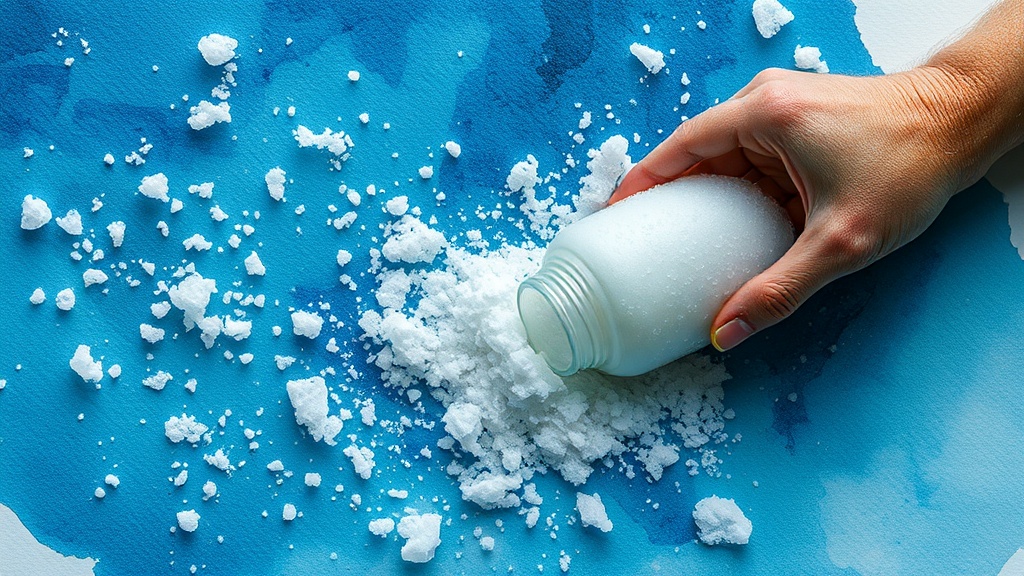
The Salt Trick: Adding Texture to Watercolor Washes

Quick Tip
Sprinkle salt onto wet watercolor paint and let it dry completely before brushing off to reveal unique crystalline patterns.
How a Kitchen Staple Creates Stunning Watercolor Effects
The salt trick is one of those watercolor techniques that looks impossibly sophisticated but costs pennies and takes seconds. Sprinkle table salt onto a wet wash, and as it absorbs pigment and water, it leaves behind delicate, crystalline patterns that mimic frost, starbursts, or coral formations. No expensive mediums. No years of training. Just chemistry doing the work for you.
How It Actually Works
Salt is hygroscopic—it pulls moisture toward itself. When you scatter grains onto wet paint, each crystal draws pigment and water from the surrounding paper. The pigment concentrates around the salt, creating lighter centers with darker, feathered edges. Once dry, you brush away the salt to reveal intricate textures that would be nearly impossible to paint by hand.
The effect varies dramatically based on your paper's wetness:
- Very wet wash: Salt dissolves partially, creating large, soft blooms with blurred edges
- Semi-damp surface: Sharper, more defined crystalline patterns
- Damp (not shiny): Tight, concentrated textures with crisp boundaries
What You'll Need
Standard table salt works fine, but experiment with grain size. Coarse sea salt creates larger, more dramatic effects; fine table salt yields subtle, delicate textures. Kosher salt sits somewhere in between. Avoid iodized salt if possible—it can sometimes leave slight discoloration on lighter pigments.
The Technique, Step by Step
- Lay down your wash quickly and evenly. Work on damp paper, not pooling wet.
- Sprinkle salt immediately while the surface still has a slight sheen.
- Leave it completely alone. Moving the paper or touching the salt ruins the crystallization.
- Let it dry thoroughly—usually 15-30 minutes depending on humidity.
- Brush off the salt with a dry, soft brush or your fingertips.
Practical Applications
This technique excels for specific textures: winter scenes and frost-covered branches, ocean foam and coral reefs, stone surfaces and cracked earth, galaxy backgrounds and star fields. It's particularly effective in the foreground of landscapes where you need organic detail without overworking the paint.
The salt does not "create" the texture—it reveals what the water and pigment want to do naturally. You're just giving them a path to follow.
Common Pitfalls
Too much salt creates muddy, indistinct blobs. Too little, and the effect barely registers. Start sparse; you can always add more. Also, salt only works on cellulose papers like Arches or Canson—it won't crystallize properly on synthetic or heavily sized surfaces.
Seal finished salt-textured pieces with fixative or spray varnish. The raised pigment deposits can be fragile and may flake if unprotected.