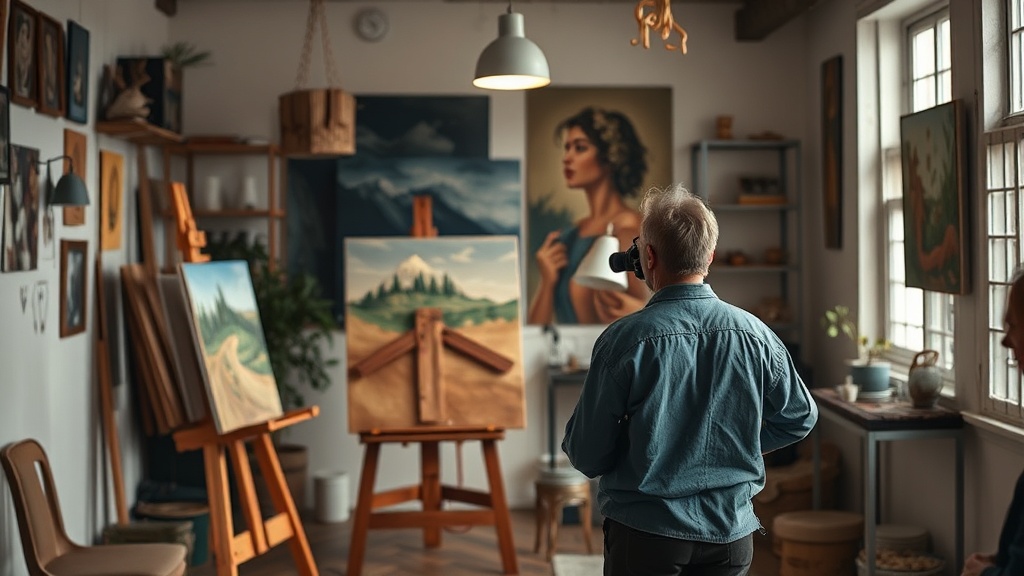
Where Do You Paint When There's No Room for a Studio?

This post covers practical strategies for creating art in small spaces—whether that's a kitchen table, a corner of your bedroom, or a fold-down wall desk. You'll learn how to set up a portable practice, store supplies without clutter, and protect your surfaces without permanent installations. No spare room required.
What Do You Really Need to Make Art at Home?
Most people think you need a dedicated studio with northern light, easels, and proper ventilation. That's nonsense—and it's exactly the kind of gatekeeping that keeps people from making anything at all.
The truth is, you need shockingly little space to make meaningful work. What you actually need is a system. A way to set up quickly, work efficiently, and put everything away without losing momentum. The size of your space matters far less than how you use it.
Start by rethinking what "studio" means. It's not a room—it's a repeatable setup. A tray table becomes a watercolor station. A storage ottoman becomes a supply cache. A rolling cart becomes your entire portable studio. The goal isn't to replicate what you see in magazines. It's to remove friction between deciding to make art and actually doing it.
Light matters more than space. If you can position your work area near a window, do it. If not, invest in a decent daylight-balanced LED lamp. Your eyes will thank you, and your color mixing will be far more accurate. Position your light source to the side of your dominant hand to avoid casting shadows across your work.
Surface protection is non-negotiable—but it doesn't have to be permanent. A large sheet of tempered masonite from the hardware store costs about $15 and creates a hard, washable work surface you can slide behind furniture when you're done. For wet media, layer in a plastic drop cloth or an old vinyl tablecloth underneath. When you're finished working, the whole setup stacks flat against a wall or slides under a bed.
How Do You Store Art Supplies Without a Dedicated Room?
Supplies multiply. It's a law of nature. Left unchecked, brushes end up in coffee mugs, paper gets wrinkled in corners, and you can never find the exact blue you need. The solution isn't more space—it's smarter containment.
Think vertically and modularly. A rolling cart with drawers (the IKEA RÅSKOG is a popular choice for good reason) lets you wheel everything to your work spot and stash it away when guests come over. Designate drawers by medium: dry materials on top, wet supplies in the middle, paper and supports on the bottom.
Brushes need to breathe, but they also need to stay clean. A canvas roll-up brush case protects bristles without the bulk of a rigid box. For paint tubes, a shallow plastic bin with a lid keeps everything visible and prevents the dreaded "tube explosion" that happens when caps get lost. Store tubes cap-down so paint stays at the opening—no more wrestling with dried caps.
Paper is often the biggest space hog. Vertical storage in a flat file drawer is ideal but impractical in apartments. Instead, use a portfolio case with rigid sides, stored flat under a bed or standing behind furniture. For works in progress, clipboards with bulldog clips keep pieces organized and visible without taking up table space. Finished pieces? Scan or photograph them, then store originals in archival boxes slid under the sofa.
The real secret: keep your active palette small. You don't need every color. A limited palette of six to eight tubes forces better mixing decisions and takes up a fraction of the space. Store the rest in a labeled box for occasional access, but keep your daily supplies lean and mobile.
Can You Really Make Serious Work in Temporary Spaces?
Absolutely. Some of the most interesting contemporary work comes from artists who embrace constraint. Temporary setups force intentionality. You can't leave a mess, so you learn to work cleanly. You can't spread out infinitely, so you learn to focus. These limitations often produce more coherent, resolved pieces than the chaos of unlimited space.
The psychological barrier is real, though. There's something about clearing away your work-in-progress that feels like rejection. Combat this by photographing your setup before you pack up. The photo becomes a promise—you can reconstruct exactly where you left off. Some artists keep a small sketchbook specifically for notes about where they stopped and what comes next.
Time limitations can actually improve your practice. When you know you only have two hours before you need to clear the dining table, you work with urgency. Decisions get made faster. Overworking happens less. The limited palette approach of artists like Picasso during his Blue Period came from constraint, not abundance—and it produced some of his most recognizable work.
Consider embracing portability as a feature, not a bug. Plein air painters have always worked this way—everything fits in a box. Your kitchen table practice is the indoor equivalent. There's a long tradition of artists working in domestic spaces: Henri Matisse made his cut-outs from a wheelchair in a small room. Frida Kahlo painted from her bed. Your corner of the living room has plenty of precedent.
Protecting Your Space (and Your Security Deposit)
Renting adds another layer of complexity. Most landlords frown on paint-splattered floors, and no one wants to lose a security deposit to a creative hobby. The good news: modern materials make it easier than ever to work cleanly.
Silicone mats designed for baking work beautifully as palette surfaces—they're non-stick, washable, and heat-resistant enough to handle any medium. When you're done, roll them up and rinse them in the sink. For the floor, interlocking foam play mats (the kind sold for children's rooms) create a cushioned, washable surface that protects against drops and spills. They're cheap, modular, and store flat.
Ventilation matters for any medium with fumes—oil paint, solvents, spray fixatives, certain adhesives. If you don't have a window nearby, work near an open door or use a small air purifier with a carbon filter. Better yet, switch to water-mixable oils or acrylics for home work, and save the heavy solvents for outdoor sessions or studio rental time.
Wet paintings need drying space. This is often the biggest logistical challenge. A collapsible drying rack designed for screen printing works well for small to medium pieces. For larger work, consider building a simple rack from inexpensive wire shelving units, fitted with removable mesh panels. When not in use, it breaks down flat.
How Do You Keep the Momentum Going?
The hardest part of a portable practice isn't the logistics—it's the psychology. When your studio disappears after every session, it's easy to let days turn into weeks. The solution is ritual, not willpower.
Set up a trigger. Maybe it's a specific playlist that goes on when the supplies come out. Maybe it's a cup of tea in a particular mug. The goal is to create a sensory signal that tells your brain it's time to work, even if you're literally working at the same table where you ate breakfast an hour ago.
Keep a project in progress visible. Even if you have to store supplies away, leave your current work out—propped on a shelf, pinned to a corkboard, clipped to a wire. Visible progress invites continued attention. Out of sight really does mean out of mind when it comes to creative practice.
Embrace the constraints. Small spaces force you to finish work. You can't start ten new pieces because you have nowhere to put them. This natural limitation breeds completion—and completion breeds confidence. Your finished pieces accumulate faster when each one demands resolution before the next begins.
The space you have is enough. The table you have is enough. The supplies you can store in a shoebox are enough. What matters isn't the square footage—it's the repetition of showing up, setting up, and making something. That's the real studio. Everything else is just furniture.