Fiber Art Isn't Craft. It's the Most Exciting Thing Happening in Contemporary Art Right Now.
Stand in front of one of Bisa Butler's quilted portraits and try to call it craft. Go ahead. I'll wait.
Butler constructs full-scale human figures from hundreds of meticulously cut pieces of African wax-print fabric, each fragment chosen for color, pattern, and texture with the same intentionality a painter brings to a brushstroke. The result isn't decorative. It isn't cozy. It's monumental. The Art Institute of Chicago's retrospective of her work—Bisa Butler: Portraits—stopped me completely when it traveled a few years back. There's a piece called The Quarry, depicting Black hunters at leisure, rendered in lush, layered textiles in a palette so precise it reads almost like Baroque painting. The material is the meaning. The fabric she chooses isn't incidental—it's doing the cultural, historical, and political work.
And yet, for most of the twentieth century, work like hers would have been filed away under "craft." Hung in a different wing, if it was hung at all. Not reviewed in Artforum. Not acquired by MoMA with any urgency.
That's not an accident. It's a system. And this Women's Day, I want to talk about exactly what that system is and why dismantling it is the most interesting thing happening in contemporary art right now.
The Word "Craft" Is Doing a Lot of Dirty Work
Let's be honest about what happened. Painting and sculpture were dominated by men. Weaving, embroidery, quilting, textile-making—these required extraordinary skill, deep material knowledge, and immense intellectual rigor, and they were done primarily by women. So the art world decided they were "lesser." Not art. Craft. A whole separate category that conveniently excluded most of what women made.
This wasn't subtle. Bauhaus co-founder Walter Gropius steered women students away from sculpture and painting and into the weaving workshop—not because they lacked ability, but because he thought textile was more appropriate for women. Anni Albers, who became one of the most innovative textile artists of the twentieth century, started there because she had no other option. She turned it into a revolution anyway. That's who we're talking about: artists who were structurally funneled into a category that was then used to diminish them.
The hierarchy that emerged—fine art above craft, conceptual above decorative, male-coded medium above female-coded medium—was never about quality or rigor or material sophistication. It was about power. About who got to decide what counted.
That hierarchy is still with us. It's just gotten better at hiding.
What's Actually Happening in Fiber Art Right Now
Here's what I want you to know: fiber and textile art is erupting. The work being made right now is some of the most formally inventive, conceptually serious, and materially sophisticated work in contemporary art. Period. Not "for fiber." For everything. This is where the strongest work by women artists is actually happening right now.
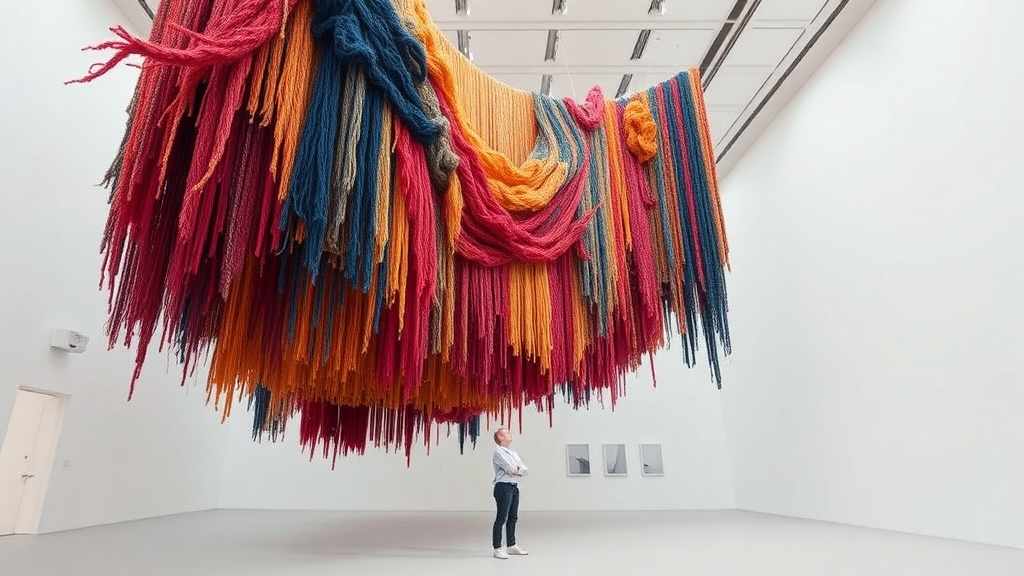
Sheila Hicks is in her early nineties and still making work that redefines what sculpture can be. Her suspended fiber installations—minimes and large-scale interventions—collapse the distance between painting, textile, and architecture. When the Pompidou gave her a major exhibition, the French art establishment had to reckon with the fact that one of the most important sculptors of the last century had been working primarily in fiber. American institutions were slower. They usually are.
Tanya Aguiñiga makes work at the US-Mexico border with communities that live and work there. Her practice is collaborative, socially engaged, and materially grounded in the textile traditions of the border region. In 2026, when the political reality of that border has never been more present, her work isn't decorative. It's documentary. It's resistance. The fiber isn't incidental to the meaning—it is the meaning, because the people who made those textiles are the people whose movement is being controlled. You cannot separate Aguiñiga's medium from her message.
Igshaan Adams, a Cape Town–based artist, weaves rope, cord, and beads into floor-to-ceiling suspended installations that map the spatial logic of South African townships, the coded geographies of apartheid-era movement restrictions, and his own experience as a queer Muslim man. The work is delicate and enormous and devastating. When it was shown at the 2022 Venice Biennale, it was among the most talked-about pieces in an exhibition that brought together artists from across the globe. Adams identifies with the fiber tradition not despite its marginalized status but partly because of it. The medium carries its own political history.
Joana Vasconcelos constructs massive crocheted and embroidered installations—Valkyrie, her aircraft-carriers of feminine labor, now familiar from the Versailles exhibitions—that ask directly: what happens when "women's work" is scaled to the size of the objects associated with male power? Her work continues to push that question into increasingly uncomfortable territory. She's not subtle about it. I love her for it.
Nadia Myre, an Anishinaabe artist based in Montreal, led a project where she invited more than two hundred participants to collaboratively re-bead the text of the Canadian Indian Act using glass beads—turning the language of colonial law back into the material practice it tried to erase. The fiber and bead work isn't illustrating a concept. It is the concept. The act of making is the act of reclamation.
These are not decorators. These are not hobbyists. These are not craftspeople in the condescending sense. These are artists with serious, sustained, rigorously developed practices who happen to work in fiber—and the institutional art world is still catching up.
Why the Material Actually Matters
One thing I hear sometimes, even from people who like this work: "Okay, it's beautiful, but is it conceptually serious?"
Yes. Stop. Let me explain why this question itself reveals the problem.
Working at scale in fiber requires technical mastery that takes years to develop. Structural engineering decisions about weight, tension, and drape. Material knowledge about how different fibers behave under light, over time, in different climates. Color theory that has nothing to do with paint mixing. The spatial logic of warp and weft isn't just craft—it's a visual grammar that's been developed over thousands of years, far longer than the tradition of oil on canvas.
More than that: the conceptual load that fiber carries is enormous. There's almost no textile material that doesn't come with history—labor history, colonial history, gendered history, economic history. When Hicks uses a particular handspun wool, that choice is legible to a viewer who knows the medium. When Adams uses the cheap synthetic cord found in South African townships, the material indexes an entire economic reality. You cannot separate the material from the meaning. That's sophistication. That's not decoration.
The old fine art/craft hierarchy assumed that "thinking" happened in painting and sculpture and that "making" happened in craft. That split was always fiction. Every serious artist is thinking and making at once. Fiber artists just happen to work in a medium that makes it impossible to pretend otherwise.
The Money Problem
Here's the data point that should make you angry: at auction, textile and fiber work still sells for a fraction of what equivalent paintings and sculptures achieve. Artists whose importance to twentieth-century art is now widely acknowledged—Hicks included—have auction records that consistently lag behind peers working in paint and sculpture who occupy comparable positions in the critical canon. The gap isn't closing nearly as fast as the critical acclaim would suggest.
This matters for a few reasons. First, market value shapes what gets acquired, what gets shown, and what gets written about. The money tells institutions what to value, and the institutions tell collectors what to buy. It's circular and self-reinforcing. Second, living artists need to sustain their practices. When fiber commands less at market, that affects studios, assistants, materials, time. It affects who can keep making work.
There are signs of change—major auction houses have been making noise about the undervaluation of textile and fiber work, and a handful of significant collectors have started paying attention. But "starting to pay attention" in 2026 for work that has been serious for sixty years is not something I can celebrate with a lot of enthusiasm. It's catching up. It's not reckoning.
What You Can Do—And Why It Actually Matters
I write Art & About because I believe the art world's gatekeeping problem is partly a viewer problem. Not blaming you—blaming a system that trains regular people to doubt their own eyes and defer to institutional authority. When MoMA hangs a painting, you're supposed to know it's important. When a gallery hangs a textile, you're supposed to wonder if it's "really" art.
Here's how to push back:
Trust what stops you. If you're standing in front of a fiber work and something in you catches—a color combination, a sense of scale, the intelligence in the structure—that's a real response to real work. Don't second-guess it because the label says "mixed media textile" instead of "oil on canvas." That moment when a piece of art stops you cold—that's the only aesthetic authority that matters.
Seek out institutions that show this work seriously. The Textile Arts Center in Brooklyn has been doing strong programming for years. The Brooklyn Museum's collection of global textiles is extensive and undervisited. The Cooper Hewitt—yes, the design museum—has been making arguments for fiber as fine art that the contemporary galleries haven't caught up to yet. Smaller nonprofit spaces often get there before the majors. Pay attention to who's hanging this work and how. Check what's on view right now and go look.
Notice the hang. When a museum puts fiber work in the decorative arts section rather than the contemporary galleries, that's a choice. You're allowed to notice it and have feelings about it.
Buy the catalog. When institutions publish catalogs for fiber and textile shows, buying them is a small and direct form of support that affects how they plan future programming.
Demand the critical writing. There's serious critical engagement with fiber art happening right now—not just "profile of a craftsperson" human interest pieces but rigorous formal and conceptual analysis. Find it. Demand it from the publications you read. Start by seeking out writing that actually teaches you how to see.
International Women's Day is not a reason to write a cheerful appreciation of women artists. I'm not interested in that. The women making fiber work right now don't need applause—they need to be taken seriously, paid fairly, and shown with the institutional weight that their painting peers take for granted. If you want to understand what genuine excellence in contemporary art by women actually looks like, that's what we're talking about.
Bisa Butler's quilted portraits should be in the permanent collections of every major American museum. Tanya Aguiñiga's border textiles should be reviewed with the same critical apparatus we bring to a Jenny Holzer installation. Igshaan Adams should be a household name in the way that artists of comparable formal achievement are household names.
That none of this is fully true yet isn't a failure of the artists. It's a failure of a system that decided, a long time ago, what counted—and built infrastructure to protect that decision.
The work is extraordinary. Go find it.
If you're in New York, start with the Textile Arts Center in Gowanus. They have programming, classes, and shows, and they take the medium completely seriously. The Brooklyn Museum collection walk is free with admission and will reframe everything you thought you knew about decorative arts. And if you see fiber in a gallery and it stops you—say something. Write it down. The critical mass we need is also made of attention.
Art is for everyone. Including this.
— Nadia