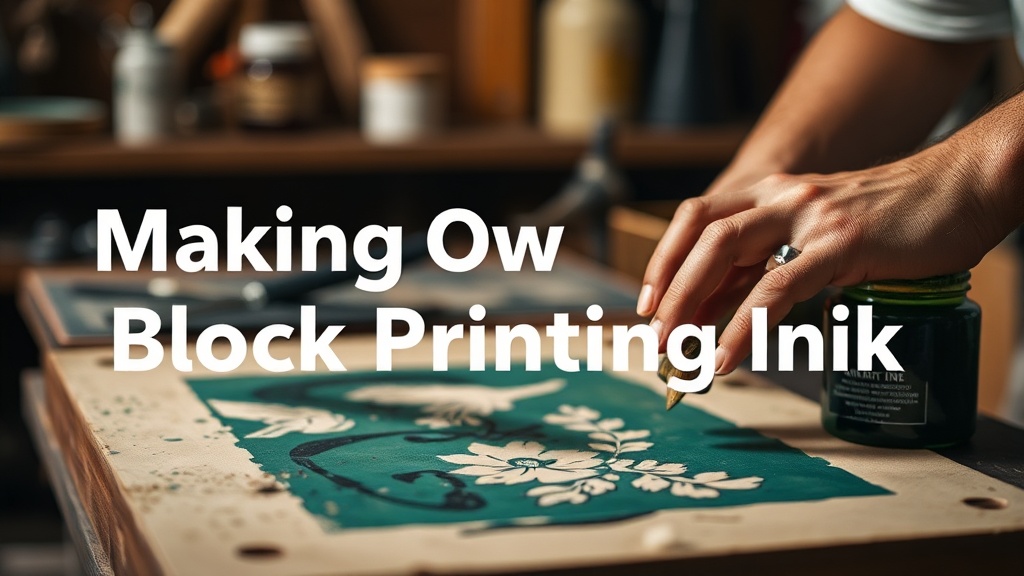
Making Your Own Block Printing Ink

The Practical Guide to Making Your Own Block Printing Ink
You are standing in an art supply store, staring at a shelf of pre-mixed relief printing inks. You want a specific, muted terracotta or a deep, moody forest green, but the commercial options are either too expensive, too neon, or simply don't exist in the exact shade you envisioned for your linocut print. This is where making your own ink becomes a practical tool rather than just a hobbyist's experiment. Creating your own block printing ink allows you to control viscosity, pigment density, and color depth, giving you total creative agency over your printmaking process.
This guide covers the technical steps for creating both water-based and oil-based relief inks. Whether you are working with small linoleum blocks or larger woodblocks, understanding the relationship between your pigment and your binder is the key to consistent, high-quality prints. We will move from the basic chemistry of ink to the specific tools you need to ensure your prints don't smudge, fade, or crack.
Understanding the Two Main Categories: Water-Based vs. Oil-Based
Before you mix a single drop, you must decide which medium suits your studio environment and your desired finish. The choice between water-based and oil-based ink dictates how you clean your tools, how long you have to work before the ink dries, and how the final print interacts with your paper.
Water-Based Inks: These are generally made using an acrylic polymer or a gum arabic base. They are much easier to clean—you can use simple soap and water—and they dry relatively quickly. These are ideal for beginners or artists working in small apartment studios without specialized ventilation. However, water-based inks can sometimes lack the "tack" or "cling" required for very fine, intricate details on textured papers.
Oil-Based Inks: Traditional relief printing often utilizes oil-based inks because they stay "open" (wet) on the block for much longer, allowing for extended printing sessions. They provide a rich, buttery texture and a deep saturation that is hard to replicate with water. The trade-off is the cleanup; you will need solvents like linseed oil, vegetable oil, or specialized citrus-based cleaners to remove the residue from your rollers and blocks.
Essential Tools and Materials
To make professional-grade ink, you cannot rely on random kitchen supplies. You need specific ratios and high-quality components to ensure the ink adheres to your block and transfers to your paper without issues. Gather the following items:
- Pigments: These can be dry powdered pigments or high-quality liquid pigments. For best results, look for artist-grade dry pigments like those found at specialized suppliers like Kremer Pigment.
- Binders: For water-based ink, you will need an acrylic polymer emulsion or gum arabic. For oil-based ink, you will need a boiled linseed oil or a specialized lithography oil.
- The Mulling Slab: A flat, non-porous surface like a piece of tempered glass or a heavy marble slab.
- The Muller: A heavy, glass tool used to grind the pigment into the binder. If you are on a budget, a heavy glass paperweight can work, but a true muller provides the necessary pressure.
- The Palette Knife: A stainless steel tool for mixing and moving the ink.
- A Brayer (Roller): To test the consistency of your ink on a scrap piece of linoleum.
Method 1: Creating Water-Based Relief Ink
Water-based ink is excellent for those who want to experiment with color transparency. If you want to create a layered effect, similar to how you might use texture in watercolor washes, you can adjust the ratio of binder to pigment to control opacity.
- Prepare the Pigment: Place a small amount of your dry pigment in the center of your glass slab. If the pigment is particularly clumpy, use a small brush to break it up.
- Add the Binder: Create a small well in the center of your pigment pile. Add your acrylic polymer or gum arabic. Start with a small amount; you can always add more, but adding too much too soon will make the ink too thin.
- The Mucking Process: Using your muller, begin grinding the pigment into the binder using a circular, figure-eight motion. You are not just mixing; you are forcing the pigment particles to be fully coated by the binder. This prevents "streaking" during the printing process.
- Check Viscosity: Once the mixture is smooth, take a small amount on your palette knife and run it across the slab. If it feels gritty, continue mulling. If it is too thick to spread, add a few drops of distilled water or more polymer.
- Test the Tack: Roll a small amount of the ink onto a scrap piece of linoleum using your brayer. If the ink "squeaks" slightly and leaves a consistent, thin film, it is ready.
Method 2: Creating Oil-Based Relief Ink
Oil-based ink is the gold standard for professional relief printers. It requires more patience and a more rigorous cleaning process, but the results are often more archival and striking.
- The Base: Start with your oil base, typically a boiled linseed oil. Place a small amount on your glass slab.
- Incorporate Pigment: Add your dry pigment to the oil. Unlike water-based ink, oil-based ink requires significant physical force to incorporate the pigment. The goal is to eliminate all air bubbles and ensure every particle is suspended in the oil.
- Grind Thoroughly: Use the muller to grind the mixture. You will notice the resistance change as the pigment integrates. A well-ground oil ink should look glossy and feel heavy.
- Adjusting the Consistency: If the ink is too "short" (meaning it breaks apart easily), add a tiny amount of more oil. If it is too "long" or runny, add more pigment or a small amount of a thickening agent like magnesium carbonate.
- The Drying Factor: Remember that oil-based ink dries through oxidation, not evaporation. This means it will stay wet on your block for a long time. If you are working on a small scale, you may want to add a "drier" (a cobalt or manganese-based additive) to speed up the process, but use this sparingly to avoid the ink drying too fast on the block.
Troubleshooting Common Issues
Even with the best materials, you might encounter technical hurdles. Here is how to solve them:
Problem: The ink is too thin and bleeding into the paper.
Solution: This usually happens when there is too much binder or liquid and not enough pigment. Add more pigment and continue mulling. Also, check your paper; if you are using highly absorbent paper, you may need a thicker, more viscous ink to prevent the ink from "feathering" into the fibers.
Problem: The print looks "salt and peppered" or has white spots.
Solution: This is a sign of poor pigment integration. The pigment hasn't been fully coated by the binder. You need to go back to the mulling stage and grind the mixture more vigorously with your muller to ensure a homogenous consistency.
Problem: The ink is drying too fast on the block.
Solution: This is common with water-based inks in dry environments. You can add a "retarder" (a slow-drying additive) or simply mist your workspace with a very fine spray of water to increase the humidity. For oil-based inks, ensure you aren't using too much of a drying agent.
Maintaining Your Tools
Cleaning your tools immediately after use is non-negotiable. If you leave oil-based ink to dry on your glass slab or brayer, you will likely ruin them. For water-based ink, use warm soapy water and a stiff brush. For oil-based ink, use a rag soaked in vegetable oil to lift the bulk of the pigment, then follow with a solvent like mineral spirits or a commercial citrus cleaner to remove the oily residue. Always finish by washing your tools with soap and water to ensure no chemical residue remains for your next session.
By taking the time to manufacture your own ink, you are moving from being a consumer of art supplies to a true practitioner of the craft. You are no longer limited by what is available on a shelf, but by what your hands can create.
Steps
- 1
Prepare your base medium
- 2
Mix in your pigment
- 3
Test the consistency
- 4
Store in an airtight container